
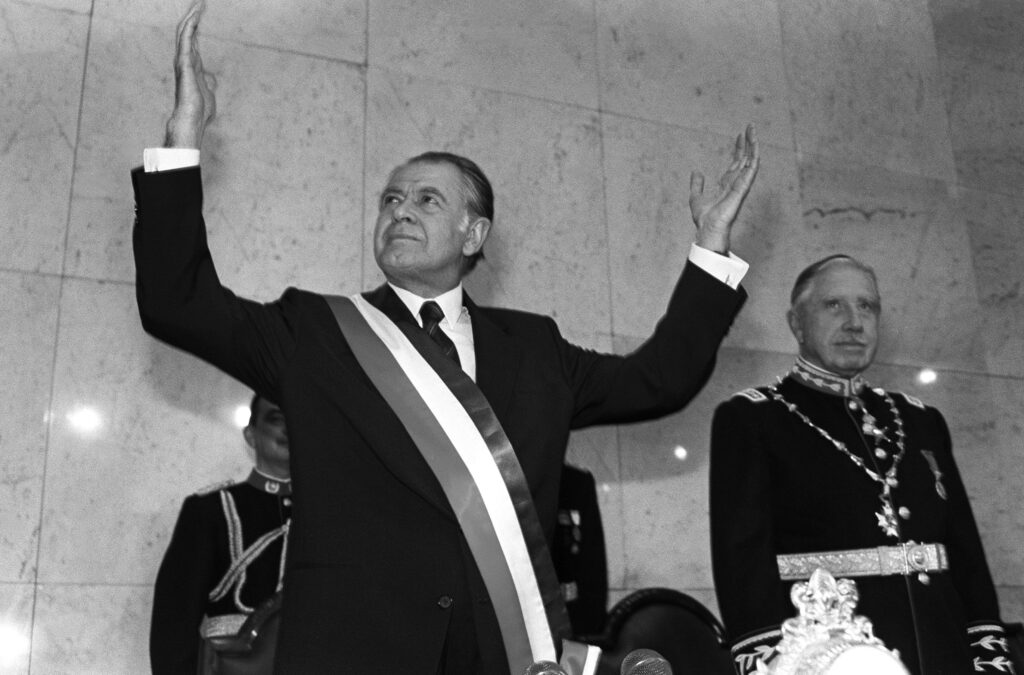
It has been almost half a century since Salvador Allende, a former president of Chile, was ousted and gone. The troubled days that followed were marked by a military coup that brought almost seventeen years of rule by the notoriously brutal military dictatorship of Augusto Pinochet. In the late 1980s, people’s discontent and hopelessness erupted in a plebiscite on the fate of Pinochet, which put an end to his rule. The first two democratic presidents after the junta, Patricio Aylwin and Eduardo Frei Ruiz-Tagle, laid in the 1990s the foundation of a slow and still controversial transition to democracy. A transition in Chile that was more than a replacement of the military rule by the civilian as it also meant to find a way to come to terms with the past. The ruling coalition and its two first representatives had to maintain national consensus, resolve social issues, break out of foreign policy isolation, and at the same time to neutralize burning issues such as who were responsible for the repression. Compared to the rest of Latin America, Chile’s transition to democracy was a political process of important features. The regime change from a civil-military dictatorship (1973-1990) to a democracy depended on the legal and political provisions of the collaborators of Augusto Pinochet. Thus to manage the complex network of inherited institutional ties, to boost the economy and to bring justice to the victims of the military dictatorship, their families and the ones who survived, it was essential to get the consensus of the political forces. It was obvious that to achieve stability and governance it was necessary to involve the institutions of the dictatorship and to embrace the neoliberal model. This was a process of coinage of new norms and political behavior that eventually led to the formation of a consensual government, which would not cut the links with the past times of dictatorship.
HISTORICAL CONTEXT
To bring about a change of the regime and to tread the long way to restoration of the democracy in Chile, the Chilean opposition has began organizing to fight the authoritarian government since the 1980s. In the beginning, despite the unanimous desire to oppose, due to a conflict in the ideological positions the opposition was seriously fragmented. Nevertheless, it was the moment when a new stage of full transition to democracy began – the differences were gradually overcome and the Concertación (Coalition of Parties for Democracy) was formed. So, when in 1988 a referendum was held on the new presidential term for Gen. Pinochet, Chileans took to the streets and voted “No”, and supported the proposition to convene presidential and parliamentary elections in the following year. The first democratic presidential election after the military junta was won by the Concertación and the Christian Democrat Patricio Aylwin. Moreover, the Coalition of Parties for Democracy nominated not only the first but also the next three presidents. Aylwin (1990-1994) was succeeded by the Christian Democrat Eduardo Frei Ruiz-Tagle (1994-2000), followed by Ricardo Lagos (2000-2006) and Chile’s first female president Michelle Bachelet (2006-2010). In this article we will focus on the first two, as the decade after the rule of Augusto Pinochet is emanation of one of the most successful trajectories in the country. Chile came out of the dictatorship and political transition was a priority. Nevertheless Pinochet remained in the political arena as commander in chief of the army and later a senator; these were years of balance in social forces. For the first governments of the Concertación, the moment, dynamics and depth of institutional change were determined by the existing opportunities in the political aspect; consensus policy determined the implementation of their programs.
Domestic political climate
The governance of the first democratically elected presidents after nearly sixteen years of authoritarian regime was of great importance to the country. They were in a situation of relative international isolation and socio-economic uncertainty. This was especially true of Patricio Aylwin’s presidency. Because of the considerable continuity in both the political and economic spheres the political administrations of the Christian Democrats Aylwin and Frei, who led the country in the first ten years of the Concertación, can be presented and analysed together. I should note, that it is no coincidence that the fact they were both representatives of the Christian Democratic Party is mentioned here, as it was the mainstay of the coalition itself, which undoubtedly contributed to ensuring the much-desired stability after that many years. Yet, let us go back to the government of Patricio Aylwin, which outlined several steps the next administration would follow: national reconciliation, international reintegration, political democratization, economic growth and social justice. As already mentioned in the context of the nascent democracy, the priority of the first governments was to ensure democratic “governance” and to avoid a return to authoritarian rule. From the very beginning, both in economic and social terms, there were signs of progress in the country. Deep reforms for social prosperity and equal capital among the population were carried out, measures aimed at eradicating extreme poverty, which the Aylwin and Frei administrations stated their intention to achieve, were taken. The most important changes were in the tax system – the increase in income tax and greater guarantees of labour. Due to the rapid growth in GDP Chile soon became a frontrunner in Latin America in terms of per capita income and, together with Uruguay, in terms of social achievement. However, despite these actions, the economic program of the war period was continued and even strengthened by concomitant failures to address the crises of socio-economic and cultural polarization and the growing alienation and discontent among the young and the poor. When we speak of the economic reality in Chile in the 1990s, it is important to note that despite all the changes in the economic and the social policy, the model remained remarkably similar to that introduced in the mid-1970s by the so-called “Chicago Boys”. This is somewhat understandable, with so much political attention focused on the downsizing, and given the wide range of countries involved, a radical change in economic policy was quite unlikely. Launching any new ideas would be very difficult given the hyperbole surrounding the Chilean “miracle” – a term referring to the macroeconomic performance of the Chilean economy, especially in the mid and late 1980s. A major challenge for the administrations of the Concertación since the 1990s was to demonstrate that they could provide for levels of economic growth similar to those achieved under authoritarianism, as well as ensure social stability and development. In general, Chile’s experience is not typical, but it can serve as an example of the relationship between institutions and economic performance. The results achieved by the country in sectors such as health, education, pensions, low trade tariffs and openness to foreign investment make it a model of neoliberal development for other emerging economies. Yet, the 1990s were a decade of polarized experience and heightened social differentiation among the Chilean population. Despite the overall performance, the socio-economic conditions for most Chileans did not improve much. In reality, for the first few years, democracy did not achieve much in terms of improving the situation for the majority of the population.
PINOCHET’S PRESENCE
On the political stage, the shift to civilian governance was also by hindered by the binding laws, institutional arrangements and the control of the 1980 Constitution, the hostility of the military governing their own transition. There was no lack of disaccord between them and the Aylwin administration. His, as well as to some extent the next government, actually drove a very limited transition. Pinochet’s presence in the army validated the belief that no lawsuits will be filed against the military hierarchy. This was undoubtedly in line with the ideological polarisation of the Chilean society regarding the dictatorial past. We should also note it was legally not possible to adjudicate the actions of the junta, because of the provision of the Amnesty Law of 1978, confirmed by the Constitutional Court, seven members of which were appointed by the previous government in 1990. Thus, we are not simply talking about a political desire to keep the situation within certain limits. However, in April 1991, the Aylwin government set up the Chilean National Commission on Truth and Reconciliation, an action that took a major step in the fight to establish the truth about the violations of human rights. Despite the dubious success of the commission’s investigation, it largely contributed to the changing of the public and the political thinking in Chile. This was also the period when, for the first time, state institutions issued official apologies and raised the issue of human rights violations at the institutional level. On the agenda of the next government, Eduardo Frei gave priority to economic development and the violations of human rights during the dictatorship became not only a secondary issue, but also practically unaddressed. During this period, the dictatorial legacy continued to bar prosecution for past crimes. This period of “closing one’s eyes”, even though to put it this way sounds a bit far-fetched, lasted until 1998, when Augusto Pinochet was arrested in London and charged with human rights violations. His arrest marked the beginning of a series of events that would take him from a seat in the Senate to retirement in 2001.
Foreign policy aspect
The foreign policy in the first ten years of Concertación’s rule was characterized by attempts to rehabilitate the country internationally. The government of Patricio Aylwin focused its efforts on participation in many national organizations and forums. By taking part in regional initiatives such as the Rio Group and other the country became a political leader in the region. Consultations on signing free trade agreements began, some of which, thanks to the continuity in the first two administrations were implemented under the next president, Eduardo Frei Ruiz-Tagle. Contacts with all surrounding countries were restored. Talks were held on joint security action. The steps for concluding a cooperation agreement with the European Union were followed, and the relations with the United States were restored and further developed. Despite the failure to join NAFTA, Chile began to conclude free trade agreements with Mexico, Canada and other countries. It also looked to the Asia-Pacific region. With Aylwin, it launched a strategy to open trade to other countries of the Latin American Integration Association (ALADI) through bilateral tariff elimination agreements. This trend intensified and continued during the presidency of Frei. It was followed by the conclusion of a number of free trade agreements with many countries on almost all continents, as well as economic and political cooperation. His administration led Chile’s joining MERCOSUR (South American Common Market / South American Regional Economic Organization), the WTO (World Trade Organization) and the APEC (Asia-Pacific Economic Cooperation). It also had significant contribution to the strengthening and development of the Chilean-Chinese relations. In 1996, the two countries signed an Agreement on Space Cooperation and an Agreement on Cooperation in Agriculture, Animal husbandry and Science and Technology. Following this path today, Chile and China are strategic partners with a long history of cooperation. The president also recorded in his notebook of international success the visit of US President Bill Clinton to Santiago in 1998. The country’s foreign policy in this ten-year period of the new democracy can undoubtedly be described as successful. Chile has taken its place in regional politics, and not only.
CONCLUSION
Despite its good intentions and the strong support of the people, the hands of the administrations of Aylwin (1990-1994) and Eduardo Frei Ruiz-Tagle (1994-2000) undoubtedly remained somewhat tied. It irrefutably launched important social, economic and foreign policy reforms, and the election of Frei and his government guaranteed that change would continue in the future. The moderate economic program, combined with the expansion of social payments, managed to ensure continuity in their mandates, and thus political stability. Against the background of foreign policy successes, things at home did not go so fast and did not achieve as much as expected. It is for sure that many of the problems were not solved during the first decade of governance, including the issue of human rights violations, but with the blessing of the electorate, they were no longer at the top of the agenda thus ensuring that the page of authoritarianism has been closed.
REFERENCES
http://portal.amelica.org/ameli/journal/137/1371808007/index.html
http://www.memoriachilena.gob.cl/602/w3-article-31414.html
https://www.scielo.cl/scielo.php?script=sci_arttext&pid=S0718-23762011000200012
https://www.cidob.org/biografias_lideres_politicos/america_del_sur/chile/patricio_aylwinazocar
https://www.elmostrador.cl/destacado/2021/08/09/progresos-en-los-gobiernos-de-la-concertacion/
https://www.bcn.cl/historiapolitica/resenas_biograficas/wiki/Eduardo_Frei_Ruiz-Tagle
http://archive.ipu.org/parline-e/reports/arc/2063_93.htm
https://www.mfa.gov.cn/ce/ceie/eng/NewsPress/t926450.htm
http://cpifa.org/en/article/1321
https://www.foreignaffairs.com/articles/chile/1989-12-01/chiles-return-democracy
Barton, Jonathan R., and Warwick E. Murray. ‘The End of Transition? Chile 1990–2000’. Bulletin of Latin American Research 21, no. 3, 2002.
Fuentes, Claudio A. “After Pinochet: Civilian Policies toward the Military in the 1990s Chilean Democracy.” Journal of Interamerican Studies and World Affairs, vol. 42, no. 3, [Cambridge University Press, University of Miami], 2000.
Ikin, M. Istoria na Latinska Amerika. Sblasak na kulturi, Sofia: RIVA, 2010.
Ree, Gerard van der. “Citizenship ‘from Above’? The Case of Chile, 1964-2010.” Revista Europea de Estudios Latinoamericanos y Del Caribe / European Review of Latin American and Caribbean Studies, no. 90, 2011.
Report of the Chilean National Commission on Truth and Reconciliation (Notre Dame, Indiana: University of Notre Dame Press, 1993), vol. I/II, Foreward, xxi-xxii. Note: Digitized and posted by permission of the University of Notre Dame Press, February 22, 2000.
Siavelis, Peter M. “Coalitions, Voters and Party System Transformation in Post-Authoritarian Chile.” Government and Opposition, vol. 37, no. 1, Cambridge University Press, 2002.
Sivilov, A. Parviyat 11 septemvri. Chili 1973-1993, Sofia: Universitetsko izdatelstvo „Sv. Kliment Ohridski“, 2013.
