
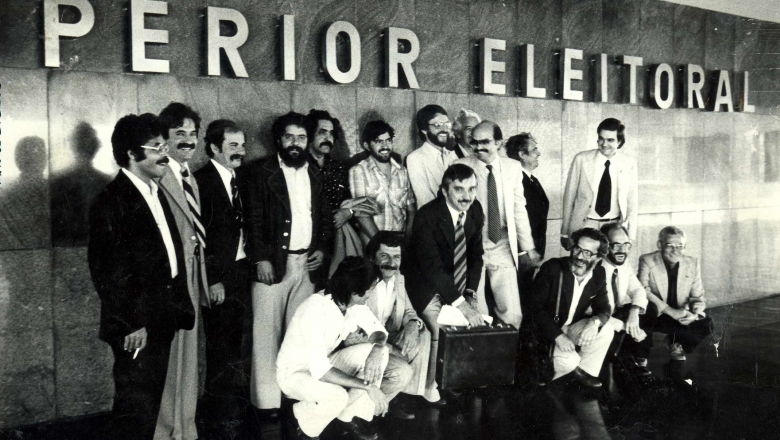
The victory of the PT (Partido dos Trabalhores – Workers’ Party) in 2002 elections was a great success for the left in Brazil and gave hope for radical reforms in the political and socio-economic sphere. Indeed, during the two terms of President Luis Inácio Lula da Silva (2003-2010), the living conditions of the poorest people improved owing to social welfare programs of federal assistance, improved access to education, and funding for the most underdeveloped North and Northeastern regions. This was true for workers as well, who have received annually increasement of the minimum wage and expanded labor rights. In addition, the PT governments contribute to the development of democratic process in Brazil because of their attempts to decentralize political decisions and promote greater non-government activism and citizens’ involvement. According to some analysts, the interaction between the state and society was changing during this period, as citizens had a greater opportunity to participate and change local or national policies. Thus, various social interests were more represented. For example, a number of new permanent national councils with citizens’ participation were being set. Over 70 national conferences dedicated on health, human rights and public security issues were being held. The Participative budgeting was activated as a process under which people were actively involved in the budget creation process. Various social movements and non-governmental organizations, such as the National Movement for Urban Reform, the Landless Workers’ Movement, and the National Confederation of Agricultural Workers, were involved in the reforms.
According to some researchers, even if the PT reforms were not revolutionary, they were sufficient for improving the living conditions of a large number of Brazilians. At least a part of Brazilian society started to believe that positive change in resolving big issues of the Brazilian democracy was in fact possible if it becomes a priority for politicians. In addition, the PT neo-developmentalist strategy seemed like an alternative to neoliberalism. In this sense, PT governments faced very high expectations for socio-economic reforms and improvement of the quality of democracy in Brazil, especially emerging from the left.
Indeed, it was due to the great hope for deep change the fall was even more severe. The premature and tragic final of the PT ruling era, which ended with the impeachment of Dilma Rousseff in 2016, was a serious blow not only to the PT, but also to the left ideas in Brazil as a whole. The lesson from Lula’s time that the left party can not govern on its own is still relevant. In the 1989, 1994 and 1998 election campaigns, the PT refused to form a coalition with parties outside the left and lost the elections, but after 2002, Lula changed that tradition and won. This caused turmoil within the party, but Lula managed to prevail thanks to his own charisma and authority. Probably the more important lesson, however, is that victory by compromising with party‘s ideology and identity has a high price to pay as it occurred in the Dilma’s second term. The broad and diverse coalitions needed to maintain a parliamentary stable majority were often based on corruption and clientelism. Some of the biggest corruption scandals in modern Brazilian history erupted under the rule of Lula and Dilma. In 2005, in the so-called Mensalão (large monthly payments), 18 members of the Brazilian parliament were accused of receiving a monthly salary from the budget in return for political support. In 2014 the so-called Operação Lava Jato (Operation Carwash) revealed huge abuses in the state oil company Petrobras of politicians from major parties, senators, Speakers of the Chamber of Deputies and the Senate, businessmen from large companies. These corruption scandals have left a huge dirty mark on the PT and the left-wing political space in Brazil. The situation is complicated by the arrest of Lula himself in 2018 on charges of corruption and money laundering. It turns out that the PT had to pay a high price for the political compromises and shortcomings of Brazilian politics, bearing the burden of public discontent.
In addition, the party left a legacy of a changed and reduced electoral base. From the very beginning of its rule, the PT lost support among some of the so-called progressive society and organizations due to its new coalition policy and compromise with the party’s traditional ideology, abandoning revolutionary methods and radical reforms. In the 1980s and 1990s, the party served as a basis for expressing the views of progressive movements and organizations such as liberal Catholics, feminists, Afro-Brazilian organizations, LGBT groups, workers’ federations such as the Unified workers’ central and the Landless Workers’ Movement. As a pragmatic course was imposed in 2002, some left-wing supporters became disillusioned and stopped supporting the PT. Nevertheless, thanks to Lula’s personal charisma, patience and ability to balance, necessary support for the party to win the elections was granted. Dilma, however, often described as rude, uncompromising and impatient, failed to retain the support gained by Lula. As Dilma does not have her own support, but inherits everything from Lula – from voters to political partners, the collapse of the PT and the left ideas was even greater. Party’s changed electoral base contribute to the process as now PT gain support from the poor and uneducated, who benefited from social welfare programs, and not from the middle class and workers. In addition, the alteration of generations is significant factor for the shift of the electoral base. After 2014, more than 60% of the electorate was born after 1970 and have no clear memory of the military dictatorship (1964-1985). In practice, part of the electorate has grown up with PT governments and has different expectations from those in power. Some say that if Dilma was of the same generation as her predecessors in the presidency, her electorate belonged to another new generation.
It is ironic, but in fact the rule of the PT did not contribute to social reconciliation. On the contrary, many believe it led to a social disorder and a growing conflict in Brazilian society. Fueled by the economic and political crisis it erupted during Dilma’s second term. For example, the upper middle class felt disadvantaged by social programs for the poorest, racial quotas in education and increased labor rights for their domestic workers. Partial and limited reforms to improve the lives of the poorest and reduce the socio-economic gap between different social groups were rapidly losing their impact in the 2013 and 2015 crises. As a result, the PT started to lose support even from workers and poor voters. According to some researchers, it was during the 2015 protests that the PT clearly distanced itself from social movements.
The 2015 protests against Dilma were different from those of 2013, as they were well organized, supported by all the mainstream media in the country, allied with the political right and included the upper middle class and the bourgeoisie. These protests were at the heart of the disintegration of the PT and the emergence of the “new right” in Brazil. The compromise policy and the lack of real reforms in the governance of the PT, often called the “path of least resistance”, led to disappointment not only in its own electorate, but form a very strong and aggressive opposition to it. This opposition was characterized as the “new right” and included a wide range of interests – big business, the upper middle class, even the working class in a broad sense for religious and ideological reasons. Part of the “new right” even carried the ideas of authoritarianism and called for the return of the military regime. Others simply wanted impeachment of Dilma Rousseff and fall of the PT government. The social base of the opposition was the upper middle class, which did not approve of raising taxes to have money for social benefits for the poorest, quotas for universities on racial and social grounds, raising the rights of domestic workers. This is an important aspect of the party’s legacy that made it possible to elect Jair Bolsonaro as president of Brazil in 2019. The failure of the left pushed the country to the far right. The wheel of history was turning again and the neo-developmentalist front was giving way to the neoliberal one.
The premature and tragic end of the PT ruling era completed a long cycle of consolidation and reform of Brazilian democracy. The country has come a long way since the military dictatorship. The reformist PT governments have actually succeeded to make partial improvements in the lives of ordinary Brazilians. The problem, however, is that improvements were limited and short-lived. The necessary qualitative and deep reforms have not been carried out, which translated into time the systemic problems of Brazilian democracy such as economic growth, social inclusion, fare social distribution, unemployment, political instability and corruption. Such structural problems require more radical and lasting reforms, and the PT failed to create the political and economic conditions for such. Brazilian society is also changing over time and setting new demands on those in power. Brazilians expect fast and quality changes in their lifestyle and environment in which to develop.
Unfortunately, Lula and Dilma’s stated good intentions for significant change failed at the end. The PT left a legacy of a deeply wounded and demoralized party, discredited left-wing policy, divided society, social inequality and social exclusion, socio-economic and political crisis, systemic problems of Brazilian democracy such as party legitimacy crisis, corruption, clientelism, violence, lack of trust in the government and lack of the rule of law, strong opposition, staggering in the far right.
Further Reading:
Brazil under the Workers’ Party. Ed. by F. de Castro et al. New York: Palgrave Macmillan, 2014.
Burton, Guy. An End to Poverty in Brazil? An Assessment of the Lula and Rousseff Governments’ Poverty Reduction and Elimination Strategies. Journal of Policy Practice, 12:3, 2013, pp. 194-215.
Garcia, Ana. Brazil under Bolsonaro: Social base, agenda and perspectives. Journal of Global Faultlines, Vol. 6, No 1 (August-October 2019), pp. 62-69.
Gouvêa, Carina Barbosa., Pedro H. Villas Bôas Castelo Branco. Populist Governance in Brazil Bolsonaro in Theoretical and Comparative Perspective. Sine loco: Springer, 2022.
Guidry. John. Not Just Another Labor Party: The Workers’ Party and Democracy in Brazil. Labor Studies Journal, Vol. 28, No 1 (Spring 2003), pp. 83-108.
Loureiro, Pedro Mendes., Alfredo Saad-Filho. The Limits of Pragmatism. The Rise and Fall of the Brazilian Worker’s Party (2002-2016). Latin American Perspectives, Issue 224, Vol. 46, No 1, January 2019, pp. 66-84.
Macaulay, Fiona. Dilma Rousseff (2011-2016): Crisis of Governance and Consensus in Brazil. – In: Women Presidents and Prime Ministers in Post-Transition Democracies. Palgrave Studies in Political Leadership. Ed. by V. Montecinos. New York: Palgrave Macmillan, 2017, pp. 123-135.
Mendes, Marcos. Inequality, Democracy, and Growth in Brazil. Amstersam etc.: Elsevier, 2015.
Rocha, Camila., Esther Solano, Jonas Medeiros. The Bolsonaro Paradox. The Public Sphere and Right-Wing Counterpublicity in Contemporary Brazil. São Paulo: Springer, 2021.
Saad-Filho, Alfredo., Armando Boito. Brazil: The Failure of the PT and the Rise of the “New Right”. Socialist Register, 2016, Vol. 52, pp. 213-230.
